Baymax — can a library of business cases reason about a new problem?
An exploratory prototype that uses a curated library of real business cases to find relevant strategic precedents and support business problem-solving. It is an experiment, not a finished product.
My work here was the concept, the business reasoning, the system prompt and the testing. The technical implementation was done with a collaborator. Nothing below is presented as production software.
The idea I wanted to test.
Most case-matching starts with the industry. You have a retail problem, so you look at retail companies. That is easy to do and often unhelpful, because two companies in the same sector can be failing for completely different reasons.
Baymax tests a different question. Instead of matching by industry, it looks for cases that share the same underlying problem, mechanism or strategic trade-off. A pricing squeeze in an airline may have more to teach a coffee chain than another coffee chain does.
The point of the prototype was to see whether that kind of reasoning could be made reliable enough to be useful, and where it breaks.
Problem in, precedent out.
Business problem → relevant cases → strategic lessons → context adaptation → recommendation. The fourth step is the one I spent the most time on, and the one that fails most often.
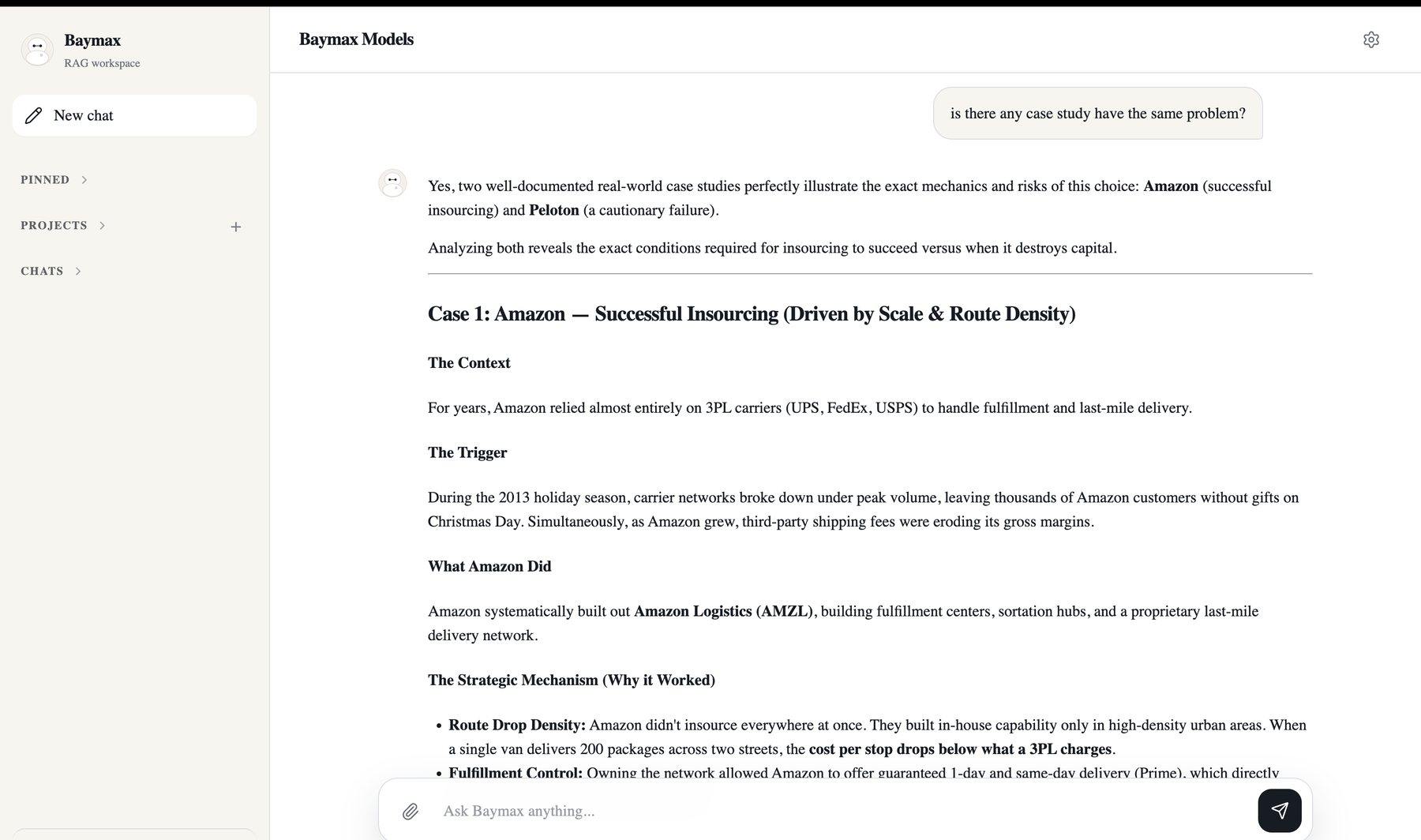
What was mine, and what was built with others.
I did the reasoning design. I did not build the system.
- The business problem-solving logic the prototype follows.
- The case library: over 100 business cases selected, summarised and structured as inputs.
- The system prompt, written and then rewritten across several rounds of testing.
- The rules for how a business case should be read, and when its lesson transfers to a different context.
- Testing the outputs and writing up where they fell short.
Ongoing: still adding cases, until the library covers business segments widely enough to be useful outside the ones I already know.
- The technical implementation and the working web prototype.
A personal experiment. No client, no organisation, no commercial use.
What the experiment taught me.
Two things came out of it, and the second is why I keep working on it.
The first is about reasoning. Useful AI-assisted business analysis does not come from finding similar cases. Similarity is the easy part, and on its own it produces confident analogies that fall apart under a follow-up question. What it depends on is naming the mechanism underneath a case, then judging honestly whether that mechanism is present in the new situation. That was the part I had to keep writing back into the prompt, because the default behaviour is to answer rather than to hesitate.
The second is technical literacy I did not have before. Building the case library and watching how retrieval changed the answers taught me how retrieval-augmented generation behaves in practice: why the way a source is summarised and structured decides whether it is ever retrieved, why a larger library is not automatically a better one, and where the model stops reasoning and starts pattern-matching. I am not an engineer and this project did not make me one. But research roles are adopting these tools, and I would rather understand how they work before I am asked to rely on them.
- A prototype. No users, no evaluation set, no measured accuracy.
- The case library is curated by hand, and coverage across business segments is still uneven.
- I designed and tested the reasoning. I did not build the system, and I do not present the engineering as mine.
- Next test: a structured way to score whether a transferred lesson actually held.
Title. Baymax — AI-assisted business case reasoning prototype.
Author. An Quach — concept, business reasoning logic, case library, system prompt, testing. Technical implementation with a collaborator.
Date. 2026, ongoing.
Why. It is the only work here I started myself, with no brief and no mark attached.
Career relevance. Working knowledge of how retrieval-augmented generation behaves, and the habit of saying where a tool fails — both relevant to research roles now adopting these tools.