Vietnam’s e-wallet market — where the engagement leaks.
Freelance market and consumer research, commissioned by a confidential client for an independent strategy case on peer-to-peer payments. The question I was given: penetration keeps rising, so why do so many wallets go quiet?
What the client asked for.
This is one of several commissioned briefs I take on a freelance basis, published here as a worked example. A private client engaged me to research the Vietnamese peer-to-peer payment market for an independent strategy case they were building. I ran the research and analysis — market landscape, consumer friction, competitor benchmarking and segmentation — and I authored the four slides shown below. I also assisted with the solution concept and rollout logic on those slides, working to the strategic direction the client set. The wider case, its final argument and the final deliverable were the client’s.
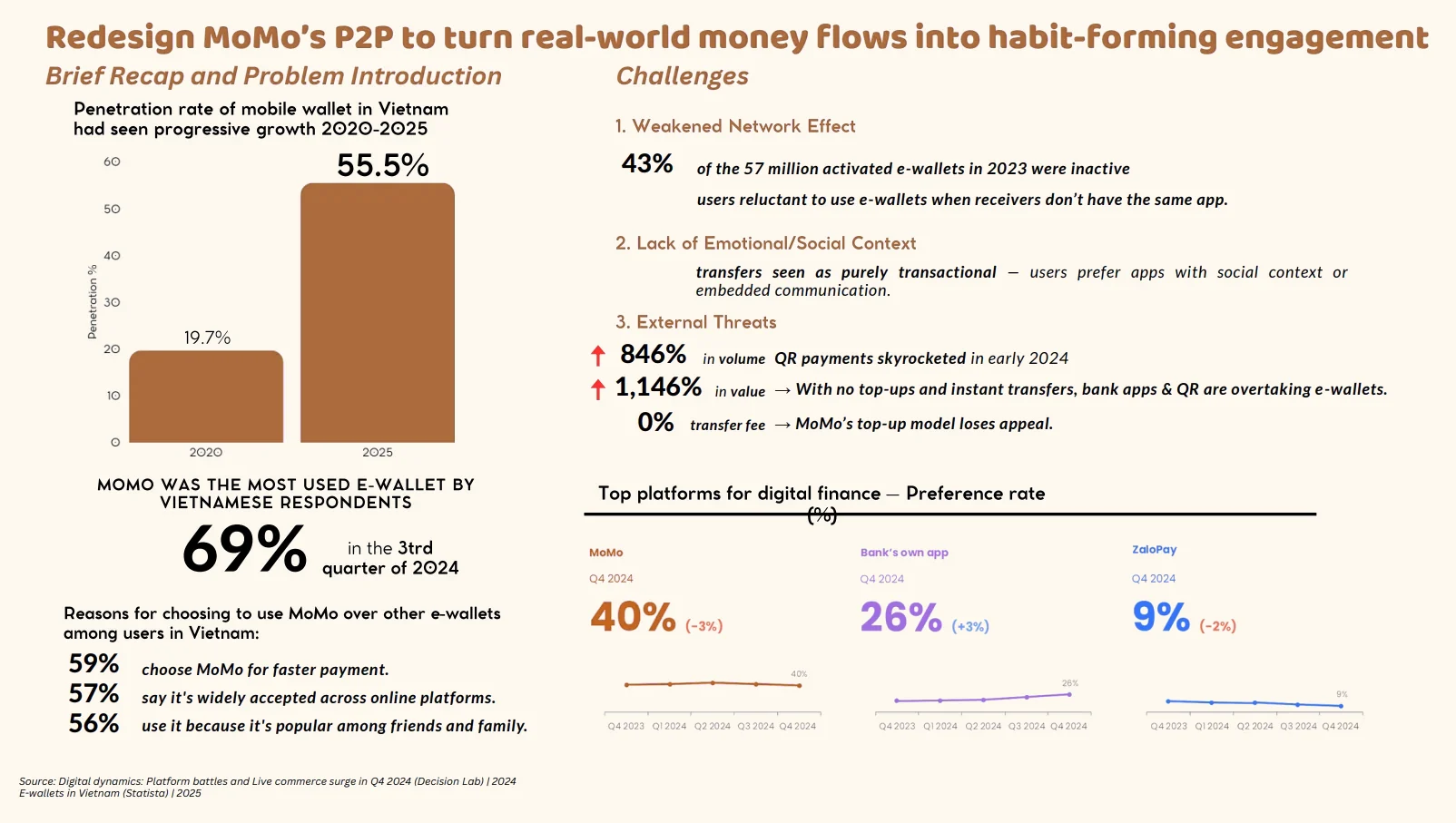
What the research found: MoMo was operating in a fast-growing but more competitive payment environment. Mobile-wallet penetration in Vietnam had risen sharply, MoMo remained the most used e-wallet among Vietnamese respondents, yet a large share of activated wallets were still inactive. At the same time, QR payments and bank apps were eroding the advantage of simple wallet-to-wallet transfers. People had the app. They were just not using it.
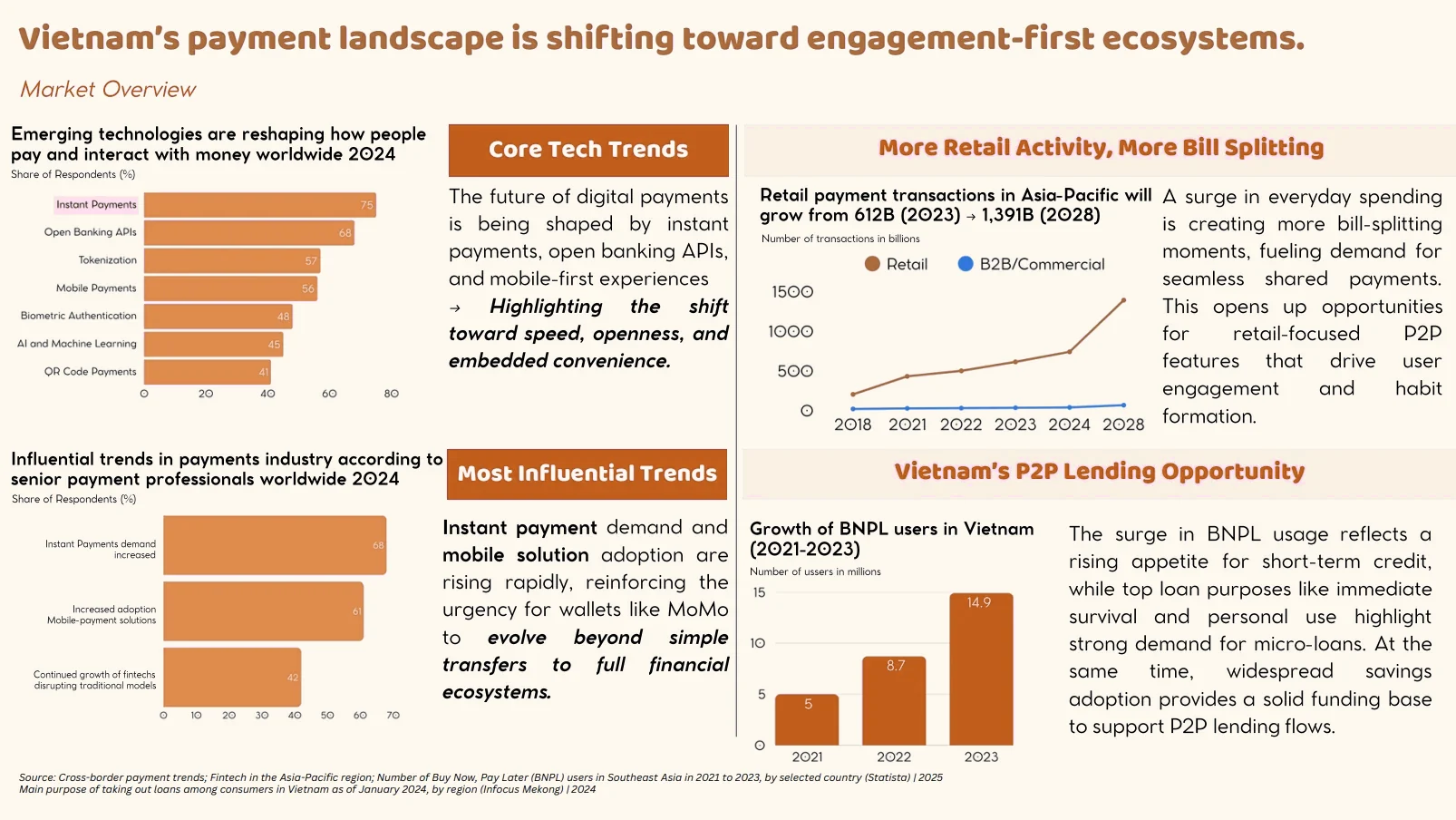
The case therefore reframed P2P as a relational product question: how could MoMo turn everyday shared payments into repeat behaviour? The strongest opportunity in the deck was bill splitting, where user demand was clear, product support remained weak, and MoMo had room to build a more social, trackable, and habit-forming experience.
How I got from market data to a recommendation.
Market pressure first, then user friction, then what to build.
Understand the payment shift before proposing the feature.
Started with Vietnam’s payment landscape: rising wallet penetration, high inactivity, weaker network effects, and growing pressure from QR payments and bank apps. This framed the case as a P2P redesign problem rather than a pure acquisition problem.
Paying was easy. Splitting was not.
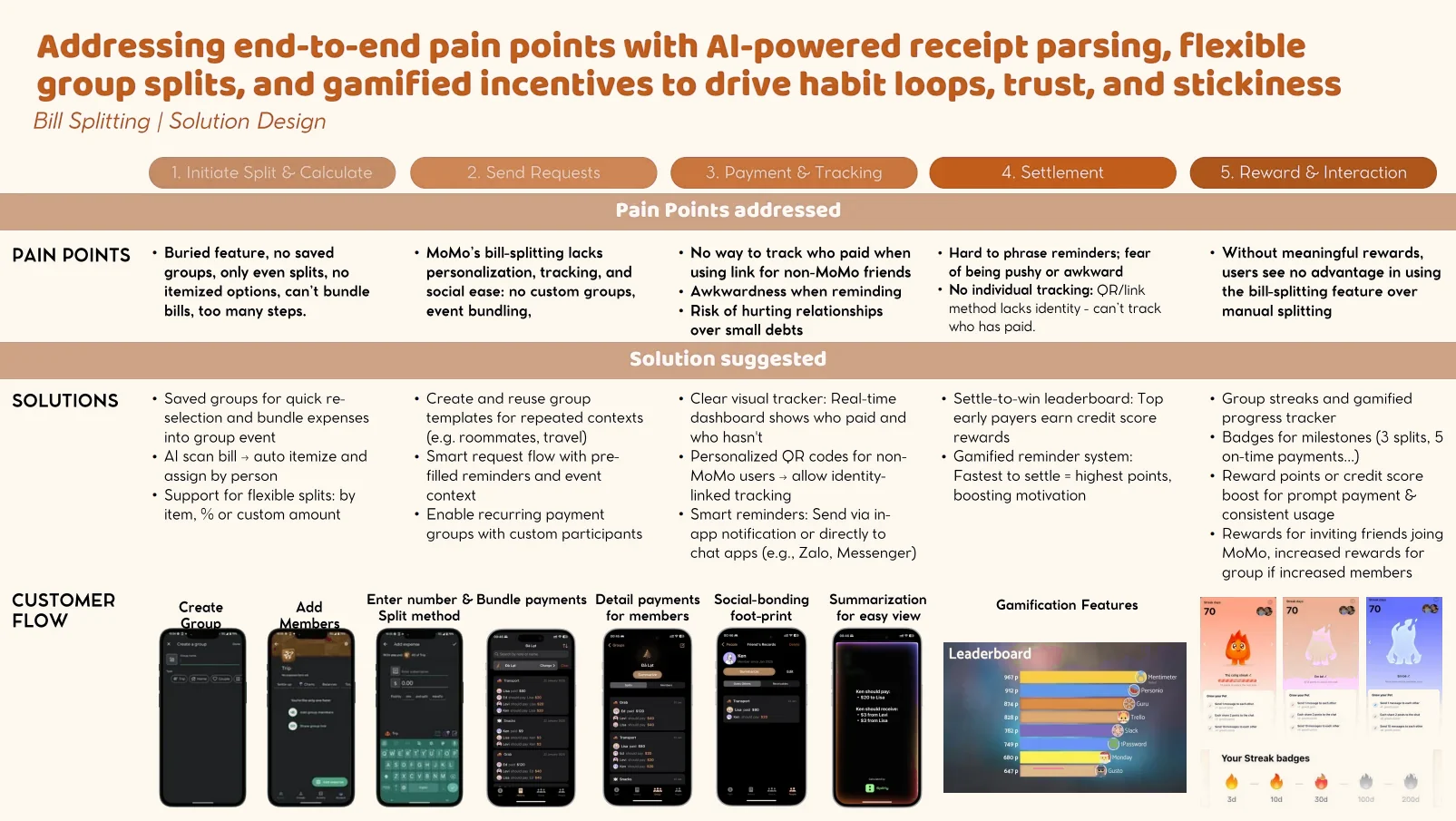
Mapped the end-to-end bill-splitting journey and identified recurring pain points: hidden entry points, even-only splits, no saved groups, weak tracking for non-MoMo users, awkward reminders, and low social payoff. Benchmarked these gaps against tools like Splitwise, Revolut, Venmo, KakaoPay, and Alipay.
Start with the users who bring others in.
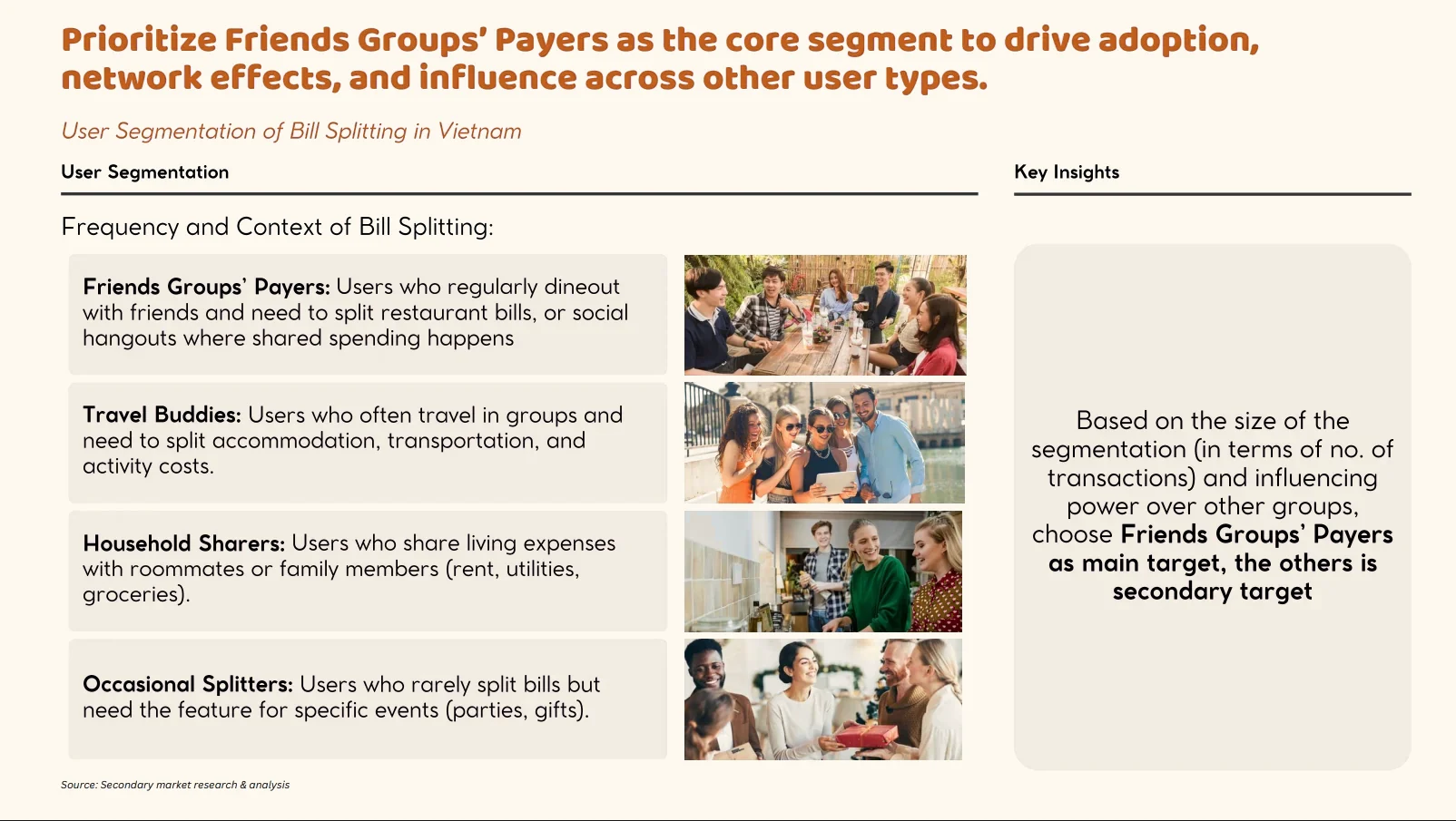
Prioritised “Friends Groups’ Payers” as the core segment, based on transaction frequency and influence over adjacent use cases like travel, rent, and gifting. The solution concept focused on saved groups, flexible splits, AI bill scanning, clearer tracking, softer reminders, and gamified incentives.
Make the feature usable first, then make it habitual.
The recommendation was phased from a core MVP into smarter tracking, reminders, gamification, and ecosystem scaling. The GTM plan leaned on MoMo’s existing user base, in-app prompts, social-first messaging, campus and lifestyle creators, and selective offline activation to make group splitting more visible and repeatable.
What I handed over.
Problem framing & market context.
A structured view of why MoMo’s existing P2P proposition was under pressure: wallet inactivity, weaker network effects, loss of transactional advantage, and the need to move toward engagement-first use cases.
User journey & competitor gap map.
A clear breakdown of where bill splitting currently fails for users, and how existing products only partially solve tracking, reminders, group flexibility, and social ease.
Segment priority & solution concept.
A recommended starting segment, paired with a feature set built around saved groups, flexible splits, AI-supported receipt parsing, better tracking, and softer social repayment mechanics.
Rollout roadmap & go-to-market plan.
A phased launch logic with success metrics, retention and virality mechanics, and a social-first GTM approach designed to make group splitting more habitual inside MoMo.
Four slides I authored.
These are the research slides I produced. Every figure on them comes from a published source, cited in the footer of the slide itself — Statista, Decision Lab, Infocus Mekong.
What the research settled.
Reframed the opportunity from generic P2P payments to a clearer relational use case: bill splitting as an entry point to stronger recurring engagement.
Turned the solution into a phased roadmap, from core MVP fixes to gamified retention mechanics and wider ecosystem scaling.
Connected user pain points to feature choices, success metrics and go-to-market actions, so the case held together from start to finish.
What was mine, and what was the client’s.
I did the research and authored these slides. The strategic direction and the wider case were the client’s.
- Research and analysis. Market landscape, user-journey mapping, competitor benchmarking, and the segmentation the case was built on.
- Slides. I wrote and designed the four slides shown here, including the solution concept and rollout logic they set out.
- Assisting on solution and rollout — developed to the strategic direction the client had already set, not to a direction of my own.
- The strategic direction the solution and rollout work was built to follow.
- The final recommendations put to the reader, and the judgement behind them.
- The engagement, the wider case and the final deliverable, which is not reproduced here.
No relationship with MoMo. No internal company data.
- Shows research solid enough for someone else to build an argument on.
- Nothing was implemented. MoMo never saw it.
- Secondary research only — no survey, no interview, no primary data.
Title. Market landscape and consumer friction — Vietnamese peer-to-peer payments.
Author. An Quach — the four research slides shown, plus the market landscape, user-journey mapping, competitor benchmarking and segmentation argument. Confidential client.
Date. May 2025.
Why. It is the only work here that someone paid me to produce.
Career relevance. Shows how secondary market evidence can support a client-facing consumer problem.